Cut, Paste, Repeat: The DIY Collage Artists Tearing Up the Rulebook One Clipping at a Time
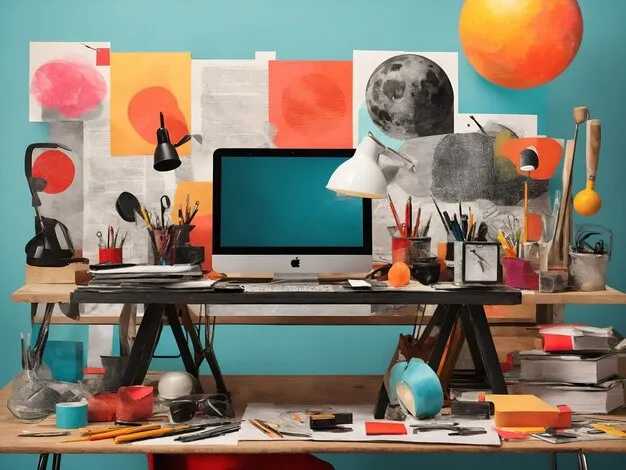
Photo: artist cutting magazine collage creative studio workspace, via img.freepik.com
There's a stack of old magazines on a folding table somewhere in a studio apartment in Chicago. Scissors, a glue stick, maybe a cracked Exacto knife. And out of that pile of outdated celebrity gossip, expired grocery store circulars, and '90s sci-fi paperbacks, someone is making something that'll get 40,000 likes by Thursday.
This is the collage rebellion — and it's been quietly building for years.
Independent visual artists across the US are doing something that's equal parts punk rock and fine art: they're taking the visual language of consumer culture, slicing it apart, and stitching it back together into something that nobody owns and everybody recognizes. It's irreverent, it's a little chaotic, and it's producing some of the most interesting work in the indie creative space right now.
What Even Is Appropriation Art Anymore?
Appropriation as a concept isn't new — Andy Warhol was literally printing soup cans in the '60s. But what's happening now feels different, partly because the tools are more accessible and partly because the internet has made the visual archive of pop culture essentially infinite.
Today's collage artists aren't just working with scissors and paper. A lot of them are blending analog techniques with digital editing — scanning hand-cut pieces and manipulating them in Photoshop, or building entirely digital collages from screenshotted imagery, old film stills, and stock photo databases. The line between "physical" and "digital" collage has basically dissolved.
What ties these artists together isn't a medium, it's an attitude. They're sampling culture the same way hip-hop producers sample music — taking something that existed in one context and forcing it into a completely different conversation. A 1950s housewife ad gets layered over a NASA photograph. A celebrity's face gets repeated in a grid until it stops being a person and starts being a pattern. A vintage anatomy illustration gets paired with a line of corporate jargon until the whole thing becomes a comment on modern work culture.
It's art that makes you feel like you've seen it before, right up until the moment it surprises you.
The Copyright Tightrope
Here's the part that makes a lot of people nervous: most of this work exists in a serious legal gray zone.
Fair use in the US allows for transformative work — meaning if an artist is genuinely changing the meaning or message of a source image, there's an argument that they're not infringing copyright. But "transformative" is a slippery word, and the legal system hasn't exactly been consistent about where it draws the line. The 2023 Supreme Court decision in Andy Warhol Foundation v. Goldsmith sent a shockwave through the art world by ruling against Warhol's estate in a case involving a Prince photograph, signaling that transformation alone isn't always enough.
Most indie collage artists aren't lawyering up over this stuff. They're making work, posting it online, and dealing with takedowns when they happen — which, for a lot of them, is part of the experience. Getting a piece pulled by an algorithm actually becomes its own kind of statement. There's something darkly funny about a corporation's automated system deciding that a cut-and-paste critique of consumer culture violates its terms of service.
Some artists are more strategic about it. They lean into imagery that's definitively in the public domain — pre-1928 photographs, government-produced materials, old encyclopedias — and use that as their raw material. Others deliberately obscure or distort source images enough that recognition becomes part of the game. You think you know where that came from. Do you, though?
Building an Audience Out of Borrowed Pieces
What's fascinating about this scene is how well it translates to social media, despite — or maybe because of — the copyright friction.
Instagram and TikTok are fundamentally visual platforms, and collage art tends to stop the scroll in a way that polished, pristine work sometimes doesn't. There's a texture to it. A roughness. You can see the seams, and that's the point. In a feed full of hyper-curated content, something that looks deliberately assembled from mismatched parts stands out.
Artists who are thriving in this space tend to share the process as much as the product. Time-lapses of physical cutting and gluing. Side-by-side comparisons of source material and finished piece. Commentary tracks explaining what they were thinking. This behind-the-scenes transparency is a huge part of the appeal — it demystifies the work while simultaneously making it more interesting.
TikTok in particular has become a discovery engine for collage artists who would have had zero institutional access five years ago. No gallery, no agent, no MFA — just a phone, some found imagery, and a willingness to explain what you're doing and why.
The Outsider Status Is the Brand
Here's the thing that keeps coming up when you talk to artists in this space: they're not trying to hide the fact that they're operating outside the mainstream art world. They're leading with it.
There's a real anti-establishment energy in collage culture that feels authentic rather than performed. These artists aren't angling for a retrospective at MoMA (though some of them have gotten gallery attention anyway). They're making work that comments on the same consumer culture that gallery spaces are embedded in, and they're doing it on their own terms, on their own platforms, sold directly through their own shops or Patreon accounts.
The outsider status isn't a liability — it's the entire point of the work. You can't make art about the absurdity of mass media from inside a well-funded institution without it getting a little complicated. But from a folding table with a glue stick? That's where the honesty lives.
What Comes Next
Collage has always been a little ahead of its time. Dada artists were doing this in the early 20th century as a response to World War I's chaos. Punk zine culture picked it up in the '70s. Hip-hop brought it to music. And now, in an era when every image ever made is theoretically one Google search away, it makes complete sense that a new generation of artists would look at that infinite archive and think: yeah, I can work with this.
The rebellion isn't going anywhere. If anything, it's getting louder — more artists, more techniques, more willingness to engage directly with the legal and ethical questions rather than pretending they don't exist.
Cut, paste, repeat. And don't apologize for any of it.